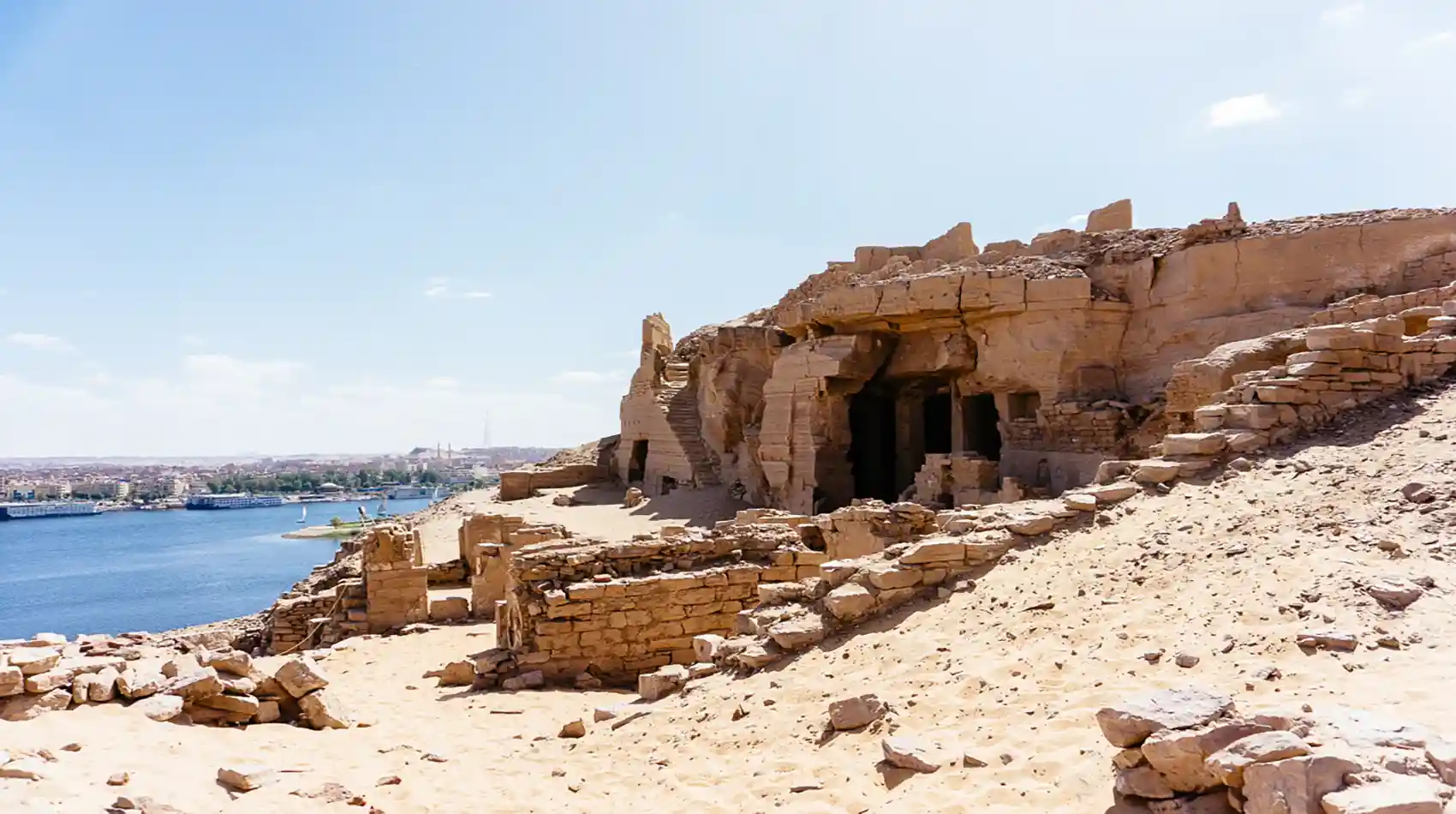

Abu Simbel temple is an archaeological site located in the middle of the mountain south of Aswan. It is a cliff of reddish sand rock, standing majestically on the west bank of the Nile (it is now on the western shore of Lake Nasser behind the High Dam), and consists of two mega temples carved into the rock mountain.
When Was the Temple of Abu Simbel Built?

It was built in 1250 BC by King Ramesses II, the third pharaoh of the Nineteenth Dynasty of Egypt. These two temples were completed on the 12th century BC and were among the greatest temples of ancient Egypt. They are usually called “The Great Temple of Abu Simbel.
A large temple for Ramses II himself and a smaller one for his preferred and third wife Nefertari. They are unique and more spacious than all Egyptian rock temples of all times. The elegant architecture, the good proportions, the magnitude of their statues, and the beauty of the inscriptions that adorn their walls made them so different and a must visit place. There are six statues at the entrance to the other temple, four of which are of Ramesses II and two of his wife Nefertari.

It consists of two magnificent structurers dates to the reign of Ramses II 13 hundred years BC. The facade of the temple consists of four large statues representing the king 20 meters high, and a door leading to the sanctuary180 feet long.
six statues form the façade of the other temple, four of which are of Ramesses II and his wife Nefertari.

Abu Simbel temple was a Rock cut temple carved into the mountains during the reign of king Ramesses II as a permanent monument to him and Queen Nefertari, to celebrate the anniversary of his victory in the Battle of Kadesh, and to intimidate the people of Nubia neighboring him.The construction of the temple complex began in about 1244 BC and continued for approximately 20 years until 1224 BC.
The temples were cover by sand for hundreds of years. The temple was forgotten until 1813, when the Swiss orientalist Johann Ludwig Burckhardt found the cornice of the main temple. Burckhardt spoke about this discovery with his Italian counterpart, the explorer Giovanni Belzoni, and they traveled together to the site, but they were unable to dig an entrance to the temple. Belzoni returned in 1817, after successfully entering the council. It was said that his men carried what they could with them from inside the temple.
The first ray of the rising sun enters the Holy of Holies, illuminating the statues and bringing the Pharaoh out of darkness, twice a year (February 20 and October 20), three statues are lightened, only the statue of Ptah stays in a dark spot on the extreme left side of the sanctuary as he was God of darkness.
Temple of Ramses II
The big temple’s façade is 33 meters high and 38 meters wide, and the temple enters the rock for a distance of 63 meters. Four giant statues of Rameses, personifying the gods, were carved in the façade. Each of the statues is 20 meters tall. The upper part of one of them is broken. Despite the huge size of these statues, the model excelled in sculpting the features of the handsome face and the delicate smile that greets the rising sun.
Above the statues is a range in which the names and titles of Rameses II are engraved: “Deified, born of the sun, and chosen by it.” Above that comes a frieze of sacred snakes, followed by a carved frieze representing monkeys in one pattern, raising their arms in greeting to the rising sun.
Above the gate in the middle of the facade is a statue of God Ra Hor-akhti.
These statues belong to members of the royal family (his mother, his beloved wife, Nefertari, and his children). It is clear that the representation of family members was influenced by Akhenaten’s ideas, which had been widespread about a century earlier. There are sculptures representing prisoners

From the gate, one arrives at a colonnaded base containing eight statues – 10 meters high, representing Rameses in the form of the God Osiris, Lord of the Underworld and the setting sun. The ceiling is decorated with falcons with outstretched wings and stars. On the walls of the column base, scenes representing the stages of the Battle of Kadesh were carved. The colonnaded hall is followed by a smaller hall, which contains four square columns on which scenes representing Ramesses II with the gods are carved.
What is the function of the side chambers on the temple of Ramses II?
On the sides of this base are several rooms for storing offerings.
After that is the Holy of Holies Chamber, and in its chest are four statues: Ptah, God of Darkness, Amun-Ra, God of gods, Ramesses, and then of God Ra, Hor-kheti, the god of the city of on (Heliopolis).
Small temple is located about 150 meters north of the Great Temple. Its facade is decorated with six statues, four of which are of Ramesses II and the other two are of his wife, the Great Queen Nefertari, united with the goddess Hathor. One passes through the entrance into a colonnaded hall, the columns of which are decorated on the front with the head of the goddess Hathor “the Good,” and on the rest of the sides are scenes of the king, the queen, and various deities.
As for the walls, they are full of scenes from the king’s life, including scenes that tell of him and Nefertari presenting offerings of flowers, food, and drinks. This hall is followed by a second hall, on the walls of which there are also scenes representing the king and his wife in the presence of the lords. Finally, one reaches the Holy of Holies and encounters in the chest a statue of the goddess Hathor.
The project to rescue Abu Simbel temples from drowning. The international donation campaign to save the temple began in 1959 because of the rising river water levels that the temple would be exposed to as a result of the construction of the High Dam and the creation of Lake Nasser.
These antiquities were threatened by drowning due to the formation of Lake Nasser behind the High Dam. Saving Abu Simbel Temple began in 1964, with a global media campaign from UNESCO to save the monuments of Nubia. In 1965, the Egyptian government, in cooperation with UNESCO, moved the temple to a nearby place with a high level that does not reach the waters of Lake Nasser.

The project included cutting the temple into large stones weighing 1-2 tons, then lifting them and assembling them in the new location. After engineering lifting, photography, and completing all types of documentation, about 150,000 cubic meters of rocks were removed from the two temples.
Then the operations of sawing their stones, weighing 10-15 tons for each piece, began, and they were transported after restoration to their new place, and installed again. It was carefully injected and applied, and that work was completed in 1966, and high-tech work began to reshape the mountain above the two temples.
A unique concrete dome with a diameter of 59 meters was placed over the large temple, and over the small temple a dome equal to half of the first, then they were covered with rocks as was the case before to support the weight of the mountain on top of it.
Then the two groups were equipped with the latest methods for measuring temperature and humidity, safety from earthquakes and disasters, ensuring lighting, and other measures that made the work a pinnacle of the work. Precision, technology and deep respect for eternity as a treasure of humanity as well as its national value. Work was completed in 1968, and the Abu Simbel site became a first-class tourist center, including an electricity generation station, a water purification station, hotels, clubs, official institutions, and other things. The two temples now stand on the shore of Lake Nasser, facing the rays of the sun that shines on them every morning. This process costed $40 million from 1964 until its transportation and reassembly was completed on September 22, 1968.