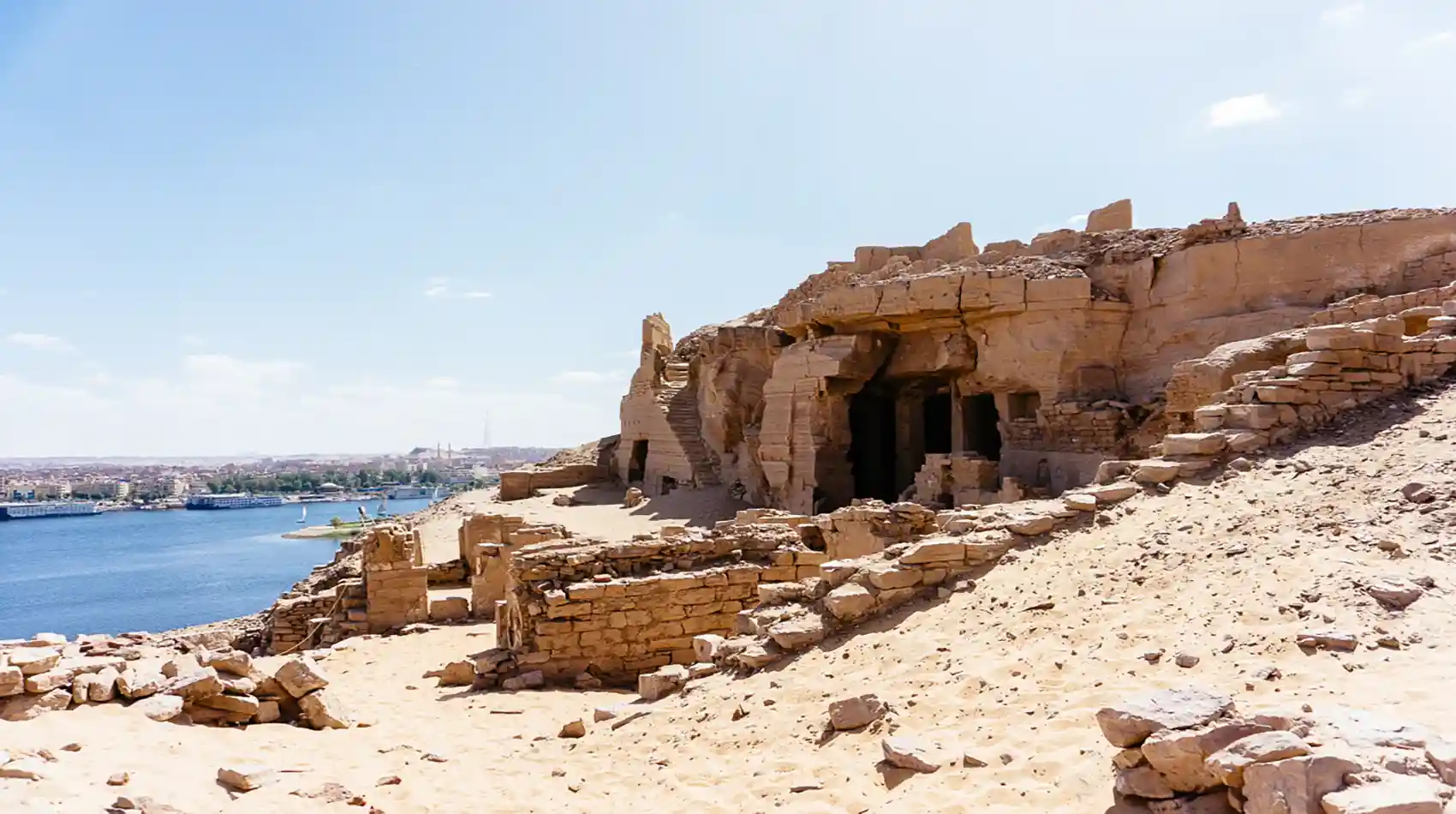

The Temple of Edfu is an Egyptian temple located on the west bank of the Nile in Edfu, Upper Egypt. The city was known during the Hellenistic and roman periods as “Apollonopolis Magna”, after the main god Horus, who was identified as Apollo under the Graeco Roman rulers. It is one of the best-preserved shrines in Egypt.
Edbo is the ancient name to the current city Edfu and it means city of spearing. The temple of Edfu or the Temple of Horus in the city of Edfu is the second largest temple in Egypt after the Temple of Karnak and represents one of the last attempts of the Ptolemies to build temples in the style and splendor of their predecessors.
It took 180 years to start and finish this complex. The engraved symbols and letters show the rituals that were followed in ancient times, and that Edfu temple building was built where a great battle took place between “Horus” and “Set.
The inscriptions of the Edfu Temple indicate that it was dedicated to the God “Hur Bhaddati,” a sacred falcon usually represented in the form of a human with the head of a falcon. The Edfu Temple contains a statue of this god in this image, and it also contains statues depicting him in the form of a falcon only.

What is noteworthy is that next to the temple there was a sanctuary for the sacred falcon in which he lived and ruled for a year. This falcon was a living bird that was elected annually and crowned, and the day of its election and coronation was considered one of the greatest annual holidays, as we will mention that later.
The temple of Horus was built between 237 and 57 BC. Ptolemy III began building it in the year 237 BC, and after 25 years had passed, the main construction had been completed. The last stone in its construction was placed in 212 BC. That is, in the tenth year of the reign of Ptolemy IV Philopator. As for decorating the walls with scenes and inscriptions, it was completed in six years, and work was completed in the year 207 BC.
In the same year, the Great Door was installed in its place. After that, a revolution broke out in upper Egypt, the fire of which did not die down until the nineteenth year of the rule of “Ptolemy V.” Epiphanes.”
When tranquility returned to the country, work continued in Edfu temple, and on the third day of February in the year 176 BC; That is, in the fifth year of the reign of Ptolemy VII (Philometor), the doors of the temple and other accessories were installed in their places. Coloring the scenes and inscriptions, decorating some of the walls with sheets of gold, and furnishing the temple took place in the few years that followed.
The construction phases of the Temple of Horus include three phases: The first: The original building stage, which is the nucleus of the temple, and is considered a complete temple in itself.
The inscriptions on its walls provide important information about the hieroglyphic language, mythology, and religion during the Hellenistic era in Egypt. In particular, the excavated texts of the temple’s construction. It provides details of each of its construction, and also preserves information about the mythological interpretation of this and all other temples as the island of creation.
There are also “important depictions and inscriptions of the sacred drama relating to the ancient struggle between goodness and evil and have been translated by the German Edfu project.

In the eighteenth year of the reign of Ptolemy IX Ergetes II, the opening of the temple was celebrated with feasts and joys. In any case, the small hall of the columns was not completed until two years after this date.
Therefore, the construction and decoration of the temple took about 180 years, including long periods of work suspension caused by revolutions and other things. As for the Hall of Mayors, the front hall, and the gates, they had not been completed. The Hall of Mayors was built in the forty-sixth year of the reign of Ptolemy IX, and the front hall was built a few years later.
Finally, the large entrance doors were installed in 57 BC. That is, in the twenty-fifth year of the reign of Ptolemy “Neos Deuces” XII. Thus, we see that the temple was completed at the time when “Julius Caesar” came to conquer Britain, and when the star of the Roman Empire began to rise and shine throughout the world. We also see that the entire duration of the construction of the Temple of Horus took about one hundred and eighty years, interspersed with some periods during which work was suspended.
The enormous temple of Edfu is located within a vast wall surrounded by a thick wall of bricks, and its main door is located on the southern side with a slight deviation towards the west from the main axis of the temple. It is not possible for a person now to know the true extent of this wall; Because the walls that exist to this day are made of bricks
A large part of it has disappeared under the current town of Edfu, and in any case the remaining inscriptions tell us that in this buried part was located the sacred lake of the temple, the altar of the temple, its kitchens, its storerooms, the barns of its livestock, its poultry, and its birds of every kind, and it is believed that it was There are the sacred tents in which the sacred falcons were raised, in addition to the temple’s tools. It is also possible that some of the priests’ residences were located in this blessed spot.
It is located directly outside the temple precincts, to the west of the main entrance and at a straight angle. The temple called “House of Birth” (distinctive). This building must have been facing from the east the Temple of the Sacred Falcon, all of whose features have now disappeared except the base of the offering table. Finally, at some distance to the west or southwest, there is what is called the Upper Temple, and other buildings other than Its origin is known, and it appears that it played an important role in the celebrations of the Holy Marriage Feast and the Feast of “Bahdati,”
The direction of the Temple of Edfu is from south to north, and in front of each wing of its gate or two pylons were two masts and an obelisk, as is the custom in Egyptian temples. However, these have now disappeared, and there was also above the main door and between the two wings of the gate the balcony of the falcon, which used to reach.
An Open Courtyard surrounded with a number of columns decorated with floral capitals on three sides. This open court was open to the public and it was known as the court of the offerings.
The hypostyle hall or the colonnade court or the hall of columns, its roof are supported by 12 columns. On both sides of the entrance of the Hypostyle Hall stands a statue of Horus one of the is still very well preserved and another broken one, which takes the shape of a falcon, also this hall is known as the outer Hypostyle Hall.
The inner hall is accessed by an entrance beyond the 1st Hypostyle Hall. Its roof is supported by 12 columns to the right and the left sides there are 2 chambers one was used as a library that once contained a large number of manuscripts. The other room was used as a laboratory.
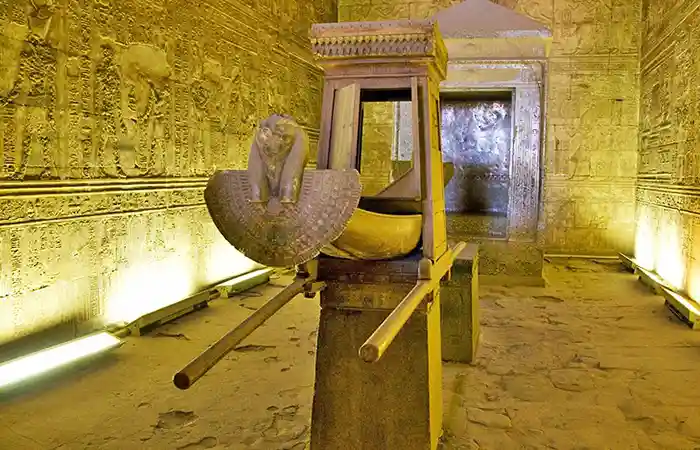
At the end of the temple is the sanctuary which includes a unique niche of gray granite where the house the golden statue of the god. In front of the Neos is a pedestal for the resting of the divine boat.
The sanctuary is surrounded by 12 chambers used for different purposes manly rooms for the triad of Osiris and many other various deities and the divine Horus and his wife Hathor.
This temple opened its doors for the great festival of the reunion between Horus and Hator where they receive the sacred boat of Hathor to rest on her man’s Horus for a divine marriage.