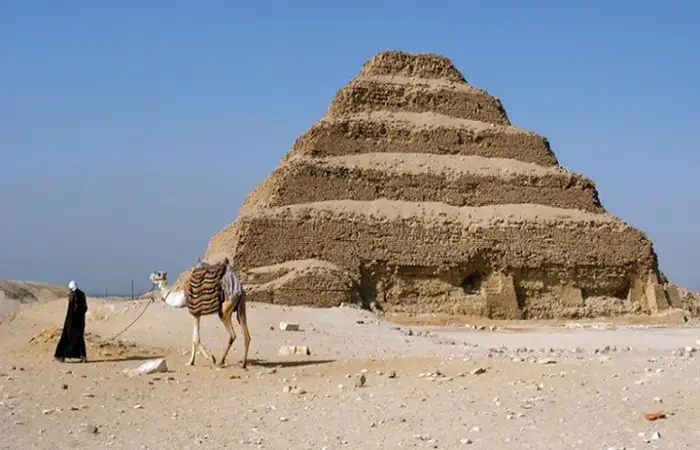

Saqqara step pyramid is considered one of the most important archaeological areas in the Egyptian state, as it is located on the opposite side of the ancient state of Memphis. This area is considered an ancient cemetery in Egypt, located on the western bank of the Nile River. Perhaps the name Saqqara goes back to the Pharaonic god Sokar, who is the god of the cemetery.

Djoser is one of the great pharaohs and belonged to the Third Dynasty, which ruled the Egyptian state in ancient times. His most famous monument is the Step Pyramid, which was built in the year two thousand eight hundred and sixteen BC. Almost 200 years before Giza pyramids.
Saqqara step pyramid is considered the oldest stone buildings in the world. It was designed by Amenhotep the great architect, who was the king’s physician, who was worshiped later in history as the God of medicine. He designed it as a tomb for the king. The length of the base of this pyramid is about one hundred and thirty meters, while its width is about one hundred and ten metres.
Its steps, which rise sixty meters, consist of six huge steps. It is a fragile limestone pyramid, and inside it there are many corridors, in addition to vestibules. There are many rooms, on the walls of which are pieces of green ceramic, The blue one contains three false doors, all of which contain inscriptions of King Djoser.
There is a statue of King Djoser in its natural size, which was found in one of the catacombs located on the northeastern side of the city of Saqqara. It is considered the oldest personalized statue of the king sitting on his throne, wearing his ceremonial robe. Located on the northeastern side of the pyramid are two terraces, which belong to the two princesses, the king’s daughters. Djoser, each mastaba contains a hall in addition to some columns.
The entire complex was surrounded by a massive mud brick enclosure wall, built of fine white limestone blocks.A fascinating detail is that these 1,680 recessed rectangular panels were carved into the stone after the wall was constructed rather than being shaped as the blocks were laid. There was a wooden door that actually could be closed and sealed when the complex was functioning.
The entrance corridor and small court lead to a passageway that opens into an elegant colonnaded court with
two rows of twenty engaged columns flanking the walkway. These take the shape of bundled reeds and may have been painted green. While in earlier phases of the complex this court was open to the sky, later it was covered with a roof.
Emerging from the entrance colonnade, by the the step pyramid enclosure wall there is a cenotaph known as the south tomb.
Within the open courtyard are a pair of large stones, shaped like a double-horseshoe and approximately 45 meters apart these are part of the Hep sed court. These Horseshoe makers were used as part of the king’s renewal rituals during the heb-sed festival. This festival was typically celebrated in Year 30 of a king’s reign and during Djoer’s lifetime, he may have performed it here to show the ability of the ruler and his performance.
Between the Entry Colonnade and courts there is a small structure called “King’s Pavilion.This structure probably used by the king to rest when he was visiting the complex for ritual actions during his earthly life
A narrow passage at the end of the Heb Sed Court leads to two courtyards running parallel to the Step Pyramid and a wall separates them. Within each a large chapel, probably intended to represent a pair of archaic shrines belonging to the goddesses of Upper and Lower Egypt—the vulture Nekhbet and cobra Wadjet

The Pyramid of Unas: This pyramid is located on the southern side of the Saqqara Pyramid. It was built to be a tomb for King Unas, who belongs to the Fifth Pharaonic Dynasty. Its rooms were engraved with hieroglyphic inscriptions, which are known as the Pyramid Texts. These inscriptions are considered the first religious document in the world.

Located at Saqqara pyramid necropolis The tomb of Mereruka, one of Egypt’s most powerful officials at a time which was built by Mereruka for his family, consists of thirty-two corridors and rooms, all located in the upper part. Mereruka allocated twenty-one rooms for himself, six rooms for his wife, and five rooms for his son. Within a group of rooms there are six columns and a niche. On the northern wall, a statue of him is installed, and it contains many inscriptions that tell of his funeral, in addition to the presence of inscriptions in some of the stones engraved with scenes of Mereruka listening to his wife playing the harp instrument, with some dancers next to her.

The tomb of Ti, was found at Saqqara step pyramid necropolis the mastaba of Ty was discovered in 1860 by Auguste Mariette which is a mastaba built by Ti for himself and Neferhoteps, his wife, is composed of two parts. In the upper section is a small hall with two columns and an engraved picture of Ti inside and outside the tomb.

On September 6, 2020, the Egyptian Ministry of Tourism and Antiquities announced the discovery of 13 wooden coffins in the Saqqara necropolis in Giza. These coffins were found perfectly stacked on top of each other at a depth of thirty-six feet, preserving some of the colors of the exterior paint.
What makes these coffins distinct from their counterparts in the grave complex there is that they remained intact for thousands of years, and they remained closed for hundreds of years after the burial process. Initial studies indicate that these coffins are completely closed and have not been opened since they were buried inside the well, and that they are not the only ones. It is likely that more of them will be found, one of which was opened, and a number of archaeological finds and wooden coffins were found inside it.
So far, the identity and positions of the owners of these coffins or their total number have not been determined, but these questions will be answered during the next few days through continued excavation work. According to the statement, the coffins were found, along with three sealed boxes, inside a well 11 meters deep.
Archaeologists and researchers have previously found coffins belonging to people from different classes of society, but finding coffins that have not yet been opened carries greater importance in turn, given the possibility of the presence of funerary objects that would tell us the importance of those buried, and teach us more about the burial customs of the ancients Egyptians.
On October 3, 2020, Egypt announced a new archaeological discovery that included 59 wooden coffins in their first condition inside burial wells next to the Saqqara step pyramid, in addition to a large number of amulets, Ushabti statues, and archaeological finds. Minister of Tourism and Antiquities Khaled Al-Anani said that the Egyptian mission working in the area found three burial wells at different depths ranging between 10 and 12 meters, containing 59 colored wooden coffins.
Most of them are in good, preserved condition and retain their original colors. He added that the coffins belonged to a group of priests and senior officials in the late era and dated back to about 600 years BC, meaning that they were closed and had not been opened for nearly 2,600 years.
He pointed out that the beginning of the excavation was three weeks ago when 13 coffins were found, then 14 others, bringing the number to 27, while the number reached 59 before the press release was issued, with the expectation that more coffins will be unearthed in the future. It is expected that these coffins will be transported for display at the Grand Egyptian Museum, which is being prepared and prepared for opening.
While in Cairo don’t miss booking either a Day tour to Sakkara, Memphis and Dahshur pyramids or Giza Pyramids, Memphis and Sakkara Pyramid Tour